
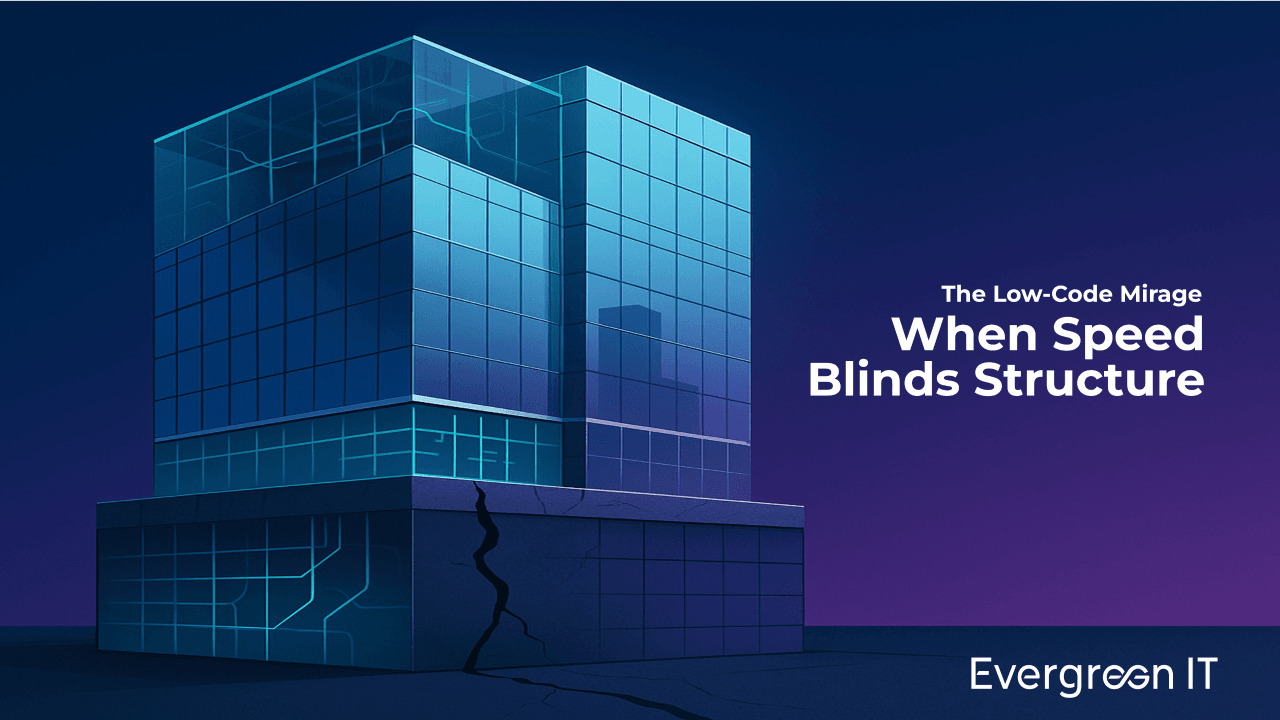
Then, the cracks began to appear. The questions started: Why were two systems, built by different teams using the same platform, calculating revenue differently? Who owned the workflow that no one remembered approving, and why did fixing a small bug in one department break a critical integration in another? The irony was sharp the program designed to simplify had multiplied the unseen complexity hidden beneath the surface.
This is the quiet paradox of Low-Code. It gives organisations the illusion that software development can move at the speed of thought, that engineering discipline is now optional. What Low-Code truly does is move complexity upstream. The syntax becomes dramatically easier, accelerating creation, but the strategic architecture becomes exponentially harder. The tools accelerate creation, but it is discipline, defined by structure, that decides whether that creation lasts and scales.
To turn Low-Code speed into sustainable strategy, organisations must address three core misunderstandings that exist at the intersection of business freedom and technical rigor.
1. The Cultural Shift: From Keyboard to Blueprint
The most significant misunderstanding is cultural: many believe Low-Code removes the need for professional engineering. It doesn't; it just shifts where that engineering happens.
In a traditional setup, developers spend time writing complex lines of code. In Low-Code, the platform handles much of the syntax. This frees developers and architects to focus entirely on defining the patterns, reusable components, and core domain models that keep the entire application landscape coherent.
When this framework is missing, chaos hides inside convenience. Business users, empowered by drag-and-drop tools, quickly create point solutions that work beautifully in isolation. They become "citizen developers" without "citizen architects." They don't know why a specific data entity or component exists, so they simply recreate a similar one. This leads to:
Component Proliferation: Multiple, slightly different versions of the same UI element or logic block exist across the environment.
Data Silos: Instead of using the centrally defined Customer data model, new apps create Client and User models, making system-wide reporting and data synchronisation impossible.
Technical Debt Multiplier: Because it was so fast to build, it often takes exponentially longer to untangle the spaghetti when these isolated apps must eventually integrate or scale.
The Solution: Engineering expertise must evolve into Architectural Governance. Developers stop coding buttons and start defining the guardrails the approved patterns and shared libraries—that ensure consistency and coherence across all business units.
2. The Governance Challenge: Designing for Trust, Not Bureaucracy
Empowering business users to build software sounds democratic and fast, but democracy without foresight and oversight quickly turns into noise. Governance is not about slowing people down; it is the design of trust. The faster you build, the more essential this structure becomes.
Effective Low-Code governance must be designed to manage two primary risks:
App Sprawl and Redundancy: Without a central inventory and mandatory review points, the same application might be built three times by three different departments, wasting time and multiplying maintenance costs.
Security and Compliance: Unmanaged business users might expose sensitive data or build workflows that circumvent established compliance checks simply because they were unaware of the rules.
The Solution: This requires a dedicated Center of Excellence (CoE). The CoE acts as the bridge, not the gatekeeper. Its roles include:
Setting the Standards: Defining the aforementioned "rails" the certified, reusable components and integration standards.
Triage and Approval: Guiding business teams to determine whether a project is a safe "Citizen Development" project, a high-impact "Professional Development" project, or simply should not be built.
Training and Mentorship: Ensuring citizen developers understand basic security and architectural principles before they deploy.
Governance, done right, is a lubricant for speed, providing clear boundaries so development can happen rapidly within safe zones.
3. The Performance & Scale Mirage: Architecture is the Engine
Even performance and scale, often sold as automatic features of a Low-Code platform, still fundamentally depend on design. Platforms like OutSystems offer immense power, but prove that scale and maintainability are always architectural properties, not simply platform features.
If developers fail to account for basic relational database design, asynchronous processing, or API payload optimization, the application will crawl when hit with real-world traffic regardless of how powerful the Low-Code platform itself is. Speed merely exposes the structure. If the foundation is weak, automation just accelerates the eventual collapse under load.
The Solution: Focus on the "Inside-Out" Design. The best Low-Code architecture adheres to clear layers:
Core (Foundational) Layer: Contains the most stable elements: core data models, security, and integration with legacy systems. This is the realm of the senior architect.
Process (Reusable) Layer: Contains common business logic and reusable modules (e.g., invoice generation, address validation).
End-User (Experience) Layer: Contains the highly fluid, fast-changing UI and user-specific workflows. This is where most citizen development safely occurs.
This layered approach ensures that high-speed changes in the End-User layer don't destabilize the core systems.
And yet, when done right, Low-Code becomes something truly extraordinary a powerful bridge between business vision and engineering discipline. It enables innovation and lets great ideas travel faster than ever before, provided they travel on rails strong enough to bear their own weight. These rails are the technical standards such as reusable components, standardized APIs, and agreed-upon data models that ensure consistency and scale.
Low-code is not the end of software engineering; it is its evolution. The organisations that treat Low-Code as an architectural discipline turn speed into strategy. The rest keep chasing simplicity and find complexity waiting, multiplied, on the other side.
#LowCode #DigitalTransformation #Leadership #SoftwareEngineering #EvergreenIT